


 Help Center
How to Open a Business Bank Account in China as a Foreign National: Bank-by-Bank Comparison and Required Documents (2024)
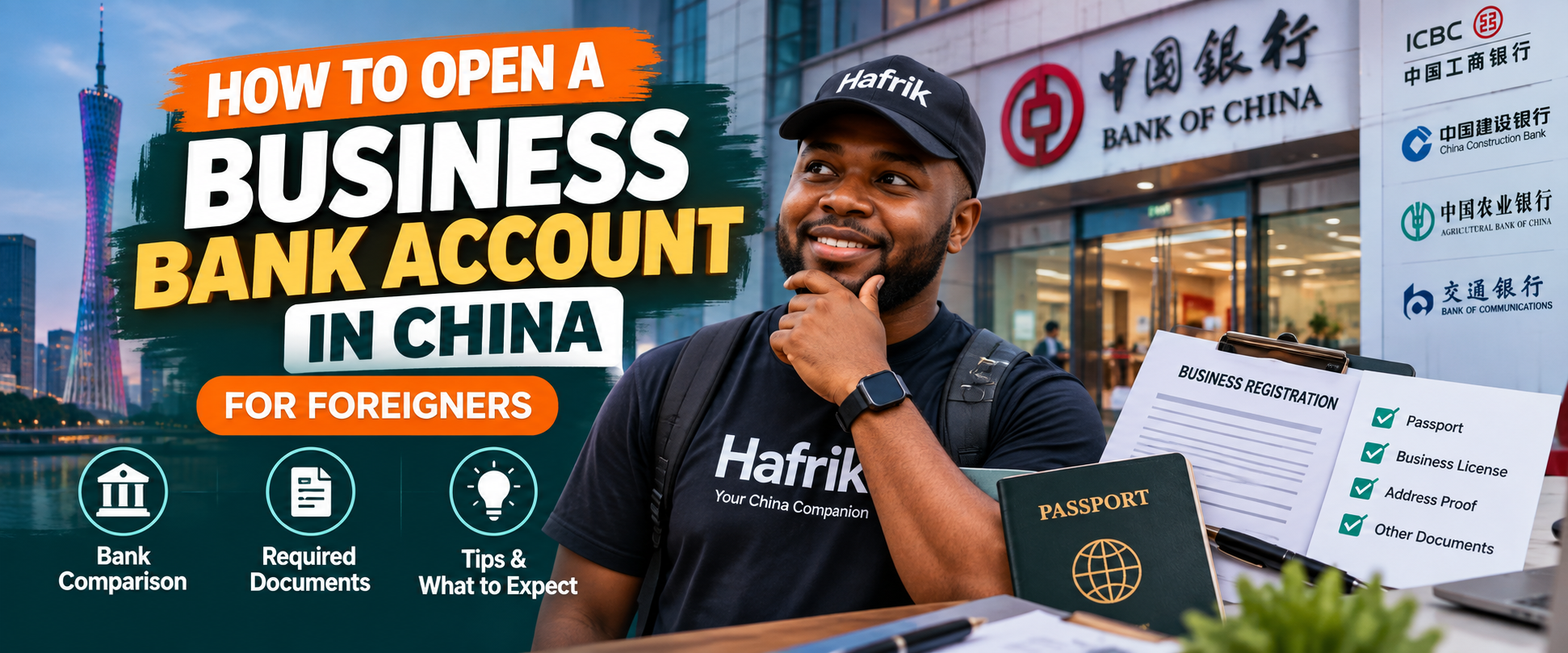
If you've registered a WFOE (Wholly Foreign-Owned Enterprise), a joint venture, or a rep office in China, you already know the paperwork doesn't stop once you get your business license. In fact, for many African entrepreneurs and business owners we talk to in the Hafrik community, opening the actual bank account turns out to be the most frustrating part of setting up shop in China — more frustrating than the company registration itself. Banks here have tightened their compliance checks significantly over the past few years, partly due to national anti-money-laundering pushes and partly due to increased scrutiny on foreign-owned entities. This guide breaks down exactly what you need, bank by bank, based on what's actually happening on the ground in 2024.
First, let's talk about why this process feels so much harder than it should. Chinese banks require in-person visits — video KYC or remote onboarding for corporate accounts is basically not a thing yet, unlike what you might be used to with digital-first banks elsewhere. You'll also find that different branches of the same bank can give you different answers depending on the city, the manager on duty, and how experienced that particular branch is with foreign-owned companies. A branch in Guangzhou that deals with African traders every day will move much faster than a branch in a smaller city that's never processed a WFOE account before. So part of the strategy here is picking not just the right bank, but the right branch.
Let's start with the documents you'll need almost everywhere, because this list rarely changes regardless of which bank you choose. You'll need your business license (营业执照) original and copies, your company chops (official seal, financial seal, and legal representative's personal seal), the organization code certificate if it wasn't merged into your business license already, your Articles of Association, a lease agreement or proof of your registered business address, and the passport of your legal representative along with their Chinese visa or residence permit. If the legal representative isn't in China to open the account personally, most banks require a notarized power of attorney, and this is where things get complicated — some banks flatly refuse to let anyone but the legal representative open the account, no exceptions. On top of this, expect to be asked for your company's actual business plan, expected transaction volumes, your main clients or suppliers, and sometimes even proof of where your registered capital is coming from. Banks are increasingly cautious about shell companies, so the more genuine documentation you can show about your actual operations, the smoother this goes.
Now let's get into the specifics, bank by bank.
Bank of China (中国银行) is generally considered the most foreigner-friendly of the Big Four state banks, largely because it has decades of experience handling cross-border trade and foreign exchange. If your business involves any international trade, import-export, or dealing with foreign currency, Bank of China is usually the default recommendation because their foreign exchange services and SWIFT transfer processes are the most mature. The downside is that because they're popular with foreigners, some branches in major cities are overloaded and appointments can take two to three weeks to get. Expect the account opening process itself to take anywhere from one to three business days once you're actually in front of a bank officer, assuming your paperwork is complete.
Industrial and Commercial Bank of China (ICBC) is the largest bank in China by assets, and it's a solid, reliable option, but it has a reputation for being stricter and slower with foreign-owned company accounts, especially in cities outside the major trade hubs. If you go this route, we'd recommend calling ahead and confirming with the specific branch that they handle foreign business accounts regularly, because getting turned away after waiting in line for two hours is a common complaint we hear.
China Construction Bank (CCB) sits somewhere in the middle — decent international services, reasonably foreigner-friendly in bigger cities like Shanghai, Shenzhen, and Guangzhou, but again inconsistent depending on branch. CCB has been actively trying to modernize its onboarding for foreign SMEs, and some users report a smoother experience here than with ICBC, particularly for smaller trading companies.
Agricultural Bank of China (ABC) is generally not the first choice for foreign nationals unless your business is specifically tied to agriculture, rural supply chains, or you're operating in a smaller city where ABC has the strongest branch network. Documentation requirements are similar to the other Big Four banks, but English-language support is less reliable, so bring a Mandarin-speaking colleague or translator if you go this route.
HSBC China is worth serious consideration if your business does a lot of cross-border transactions, especially with markets in Africa, the Middle East, or Europe, since HSBC's global network makes international wire transfers noticeably smoother and faster than the domestic Chinese banks. The trade-off is that HSBC tends to have higher minimum balance requirements and more rigorous compliance checks upfront — they will scrutinize your business model closely before approving the account, and the whole process can take longer at the front end even if transfers are faster once you're up and running. HSBC is a favorite among businesses that need genuine international banking capability rather than just a domestic RMB account.
Standard Chartered China is similar to HSBC in positioning — strong for international trade finance, good English-language service, but again with tougher initial due diligence. If your company plans to apply for trade finance products, letters of credit, or needs sophisticated FX hedging down the line, Standard Chartered's corporate banking services are built for exactly that kind of client.
China Merchants Bank (CMB) and China CITIC Bank are increasingly popular with smaller foreign-owned trading companies, particularly in Guangzhou and Yiwu, two cities with large African trading communities. These banks have adapted faster to the needs of foreign SME owners doing import-export business, and several members of the Hafrik community have reported quicker turnaround times here compared to the Big Four, especially for straightforward RMB corporate accounts without complex FX needs.
A word specifically for those of you running businesses out of Guangzhou or Yiwu, since these two cities have the largest concentrations of African entrepreneurs in China. Branches near Sanyuanli and Xiaobei in Guangzhou, and around the International Trade City in Yiwu, deal with foreign trading companies constantly, and staff there are far more accustomed to processing accounts for African-owned businesses than branches elsewhere. It genuinely pays to open your account at one of these specialized branches even if it means a slightly longer commute, because the staff already know the drill, often have some English or at least experience communicating with non-Mandarin speakers, and the whole process moves faster because they're not treating your application as unusual.
One thing that catches a lot of people off guard: the bank will typically require the legal representative to appear in person, sometimes on more than one occasion, and some banks now conduct a short interview about the nature of the business, sometimes recorded on video for compliance purposes. Come prepared to explain, clearly and confidently, what your business does, who your clients are, and roughly how much money you expect to move through the account monthly. Vague or inconsistent answers are one of the top reasons applications get delayed or rejected, so rehearse this with your accountant or business partner beforehand if your Mandarin isn't strong enough to explain it smoothly yourself.
Another practical tip: register your business capital account first if required, since some banks want to see that your registered capital has already been injected before they'll open your general operating account. The order of operations here trips up a lot of first-time founders, so it's worth confirming with your accountant or a local company formation agent exactly which account needs to be opened first based on your business structure and the bank you've chosen.
Finally, budget for time. Even with everything in perfect order, expect the full process — from first appointment to receiving your account details and online banking token — to take anywhere from one to four weeks depending on the bank and branch. Rushing this or trying to cut corners with incomplete documentation almost always backfires and costs more time in the long run. If you can, work with a local agent or a bilingual accountant who has recently opened accounts for other foreign businesses at your target bank; their relationship with the branch and up-to-date knowledge of current requirements can save you weeks of back-and-forth. The rules shift more often than you'd expect, and what worked for someone else's business account last year may already be slightly out of date by the time you walk in the door.

🚀 Promote Your Hustle
Whether you sell food, fix phones, or cut hair — Hafrik helps you grow. Free business pages now open!
Create Page Portuguese
 English Language
 Arabic
 French
 Spanish
 Deutsch
 Turkish
 Dutch
Dutch
 Italiano
 Russian
 Romaian
 Portuguese (Brazil)
 Greek
Greek